 VapeWholesaleHub
How to Brief a Factory on 18650 Battery — Small Batch Buyers
18650 Battery has moved from a niche listing to a category that most vape retailers simply have to carry. That popularity brought a flood of near identical offers. This guide explains how to separate a repeatable supply chain from a lucky sample.
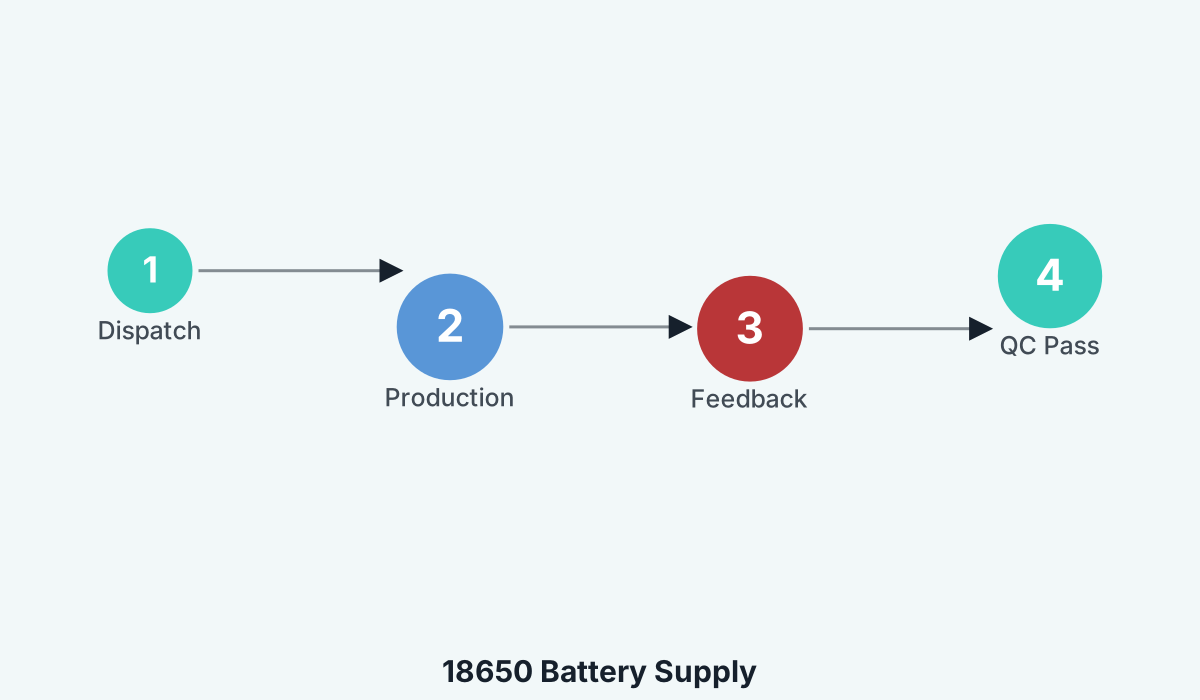
Turning 18650 Battery Into Repeats
Staff knowledge moves 18650 battery more than any fixture. A two minute explanation of the difference between this line and the one next to it converts a browsing shopper into a repeat buyer far more reliably than a discount.
A 18650 battery display that answers strength and flavour without staff involvement outsells a prettier one that does not. Most customers will not ask, so the fixture has to do the work.
Where 18650 Battery Sits in the Range
Before anything else, decide which customer you are buying 18650 battery for. A convenience counter with limited shelf depth needs a tight range that turns quickly, while a specialist shop can carry a deeper ladder of options and educate buyers into higher ticket lines.
A tight 18650 battery range with deep availability usually outsells a wide range with thin stock. Customers who find their line in stock come back; customers who are told to wait do not.
The Specification That Matters
Good 18650 battery specs describe the failure boundaries, not just the target. Stating what is unacceptable gives the factory a clear production window instead of a single point they will miss half the time.
| Product category | Disposable |
|---|---|
| Resistance band | 0.8 - 1.0 ohm |
| Capacity tolerance | +/- 3% |
| Puff count method | Machine cycle 2s on / 18s off |
| Master carton | 240 units |
| Carton weight | 11.7 kg |
| Shelf life | 24 months |
| Storage | 15-25 C, dry, away from direct light |
What 18650 Battery Really Costs Landed
Build 18650 battery price tiers around order sizes your customers actually place. Tiers that only make sense on a spreadsheet get ignored, and you end up discounting ad hoc instead.
Indicative reference points for planning purposes: entry tier from USD 1.44 per unit at 1000 units, mid tier at USD 0.93, and volume tier at USD 1.38 for full container quantities. These figures move with specification, packaging and freight, so treat them as a shape rather than a quote.
Getting 18650 Battery to Your Warehouse
Track 18650 battery landed cost per unit as a running number, including duty and local delivery. It is the only figure that tells you whether a supplier change actually improved anything.
Inspection Before Dispatch
The defect rate that matters is the one your customer experiences, not the one the factory reports. Bridge that gap by inspecting the way a customer would open the box, not the way a line worker packs it.
Train whoever receives 18650 battery cartons to note anything unusual at the point of unloading. Damage discovered at the dock is a freight claim; damage discovered a week later is your problem.
- Check carton dimensions against your freight quote before confirming.
- Ask how the factory measures puff count, then compare like with like.
- Confirm the current customs classification with your own broker.
- Agree the tolerance band in writing before approving artwork.
- Start with a mixed carton and let your own sell-through decide.
Practical Checklist
- Start with a mixed carton and let your own sell-through decide.
- Check carton dimensions against your freight quote before confirming.
- Rotate stock by batch code rather than by delivery date.
- Ask how the factory measures puff count, then compare like with like.
- Agree the tolerance band in writing before approving artwork.
- Write the complaint threshold into the order terms.
Frequently Asked Questions
What does a sample pack usually include?
A typical 18650 battery sample pack covers the strengths or variants you are most likely to list, packed so you can evaluate them side by side. Tell us which lines you are considering and we will match the pack to that rather than sending a generic selection.
What if I only need a small first order?
That is normal and sensible. A mixed carton lets you test 18650 battery in your own market before committing to a production run, and the specification you approve at that stage carries through to larger orders unchanged.
Can you match an existing product I already sell?
Often yes, provided we can measure it properly. Send a physical sample and we will report back on what can be matched, what will differ slightly, and why. An honest gap is more useful than a vague promise.
How are price changes handled on repeat orders?
{K} pricing is reviewed against input costs and volume rather than adjusted casually. Any change is confirmed in writing before the next order is scheduled, with the reason stated so you can judge it yourself.
Can I mix strengths in one order?
In most cases yes, as long as each strength meets the minimum run length. Mixed strength cartons are popular with retailers building their first display because they show the full ladder without over committing.
Next Step
Questions that are not answered here are usually the interesting ones. Reach out with the specifics of your market and we will answer with numbers rather than adjectives.
Related Reading
- 18650 Battery First Order Playbook for New Importers — Small Batch Buyers
- 18650 Battery Bundle Pricing That Moves Older Stock — Private Label Programmes
- 18650 Battery Flavour Development: From Brief to Production — Wholesale Clubs
- 18650 Battery KPI Set for Wholesale Operations — Tight Margin Categories
- 18650 Battery Cell and Chip Supply Constraints — First-Time Importers
- 18650 Battery Handling Product Recalls Professionally — Mixed Cabinets