 VapeWholesaleHub
18650 Battery Shelf Rotation for Multi Site Retailers — Freight Included
We ship 18650 battery to distributors in very different markets, and the same five questions come up almost every week. Rather than answer them in email each time, we have written them out properly here.
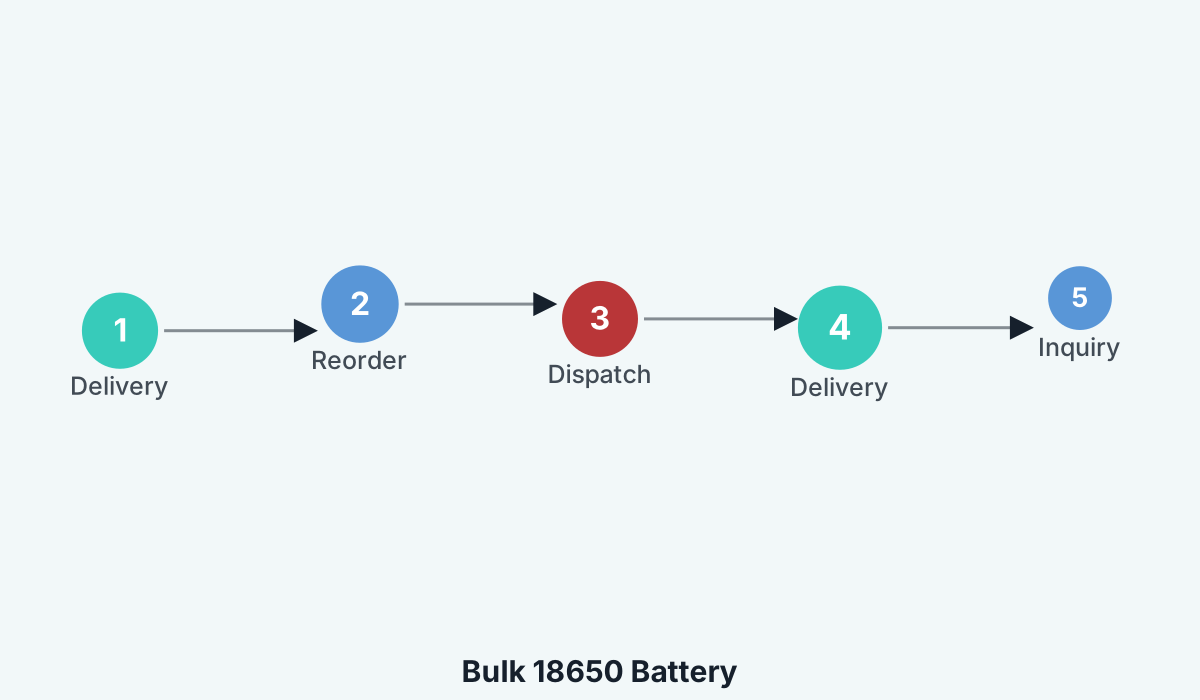
Positioning 18650 Battery on Your Shelf
18650 Battery sits at an interesting point in the assortment. It is familiar enough to be an impulse purchase and specific enough to build a repeat pattern around. Treating it as either pure commodity or pure specialty both lead to poor results.
Inspection Before Dispatch
The defect rate that matters is the one your customer experiences, not the one the factory reports. Bridge that gap by inspecting the way a customer would open the box, not the way a line worker packs it.
- Confirm the current customs classification with your own broker.
- Agree the tolerance band in writing before approving artwork.
- Model landed cost, not ex-works price, when comparing quotes.
- Start with a mixed carton and let your own sell-through decide.
- Ask how the factory measures puff count, then compare like with like.
Freight, Customs and Timing
Carton dimensions for 18650 battery are a design decision, not a packing afterthought. A few centimetres on the master carton can change how many units fit a pallet, and that repeats on every order.
Freight is the hidden half of 18650 battery unit economics. A denser master carton can save more per unit than a hard negotiation on factory price, because the saving repeats on every reorder rather than once.
Market Signals
Expect 18650 battery packaging requirements to keep tightening. Designs that leave room for additional labelling age better than tight layouts that need a full reprint to comply.
The Specification That Matters
Revisit the 18650 battery specification after every third order. Small improvements compound, and factories take a buyer more seriously when the document has clearly been used.
Revisit the 18650 battery specification after every third order. Small improvements compound, and factories take a buyer more seriously when the document has clearly been used.
| Product category | Closed pod |
|---|---|
| Resistance band | 0.8 - 1.0 ohm |
| Capacity tolerance | +/- 3% |
| Puff count method | Declared by capacity |
| Master carton | 240 units |
| Carton weight | 10.1 kg |
| Shelf life | 24 months |
| Storage | 15-25 C, dry, away from direct light |
Pricing and Margin
When 18650 battery input costs move, ask which component moved. A generic price increase hides whether you are paying for cells, packaging or simply a busy production calendar.
Indicative reference points for planning purposes: entry tier from USD 2.03 per unit at 1000 units, mid tier at USD 1.19, and volume tier at USD 1.31 for full container quantities. These figures move with specification, packaging and freight, so treat them as a shape rather than a quote.
Practical Checklist
- Keep sealed retained samples from every production batch.
- Rotate stock by batch code rather than by delivery date.
- Model landed cost, not ex-works price, when comparing quotes.
- Write the complaint threshold into the order terms.
- Agree the tolerance band in writing before approving artwork.
- Plan the switch from air to sea freight before you need it.
Frequently Asked Questions
What happens if my market changes its rules?
Regulations move, and packaging or documentation sometimes has to follow. We keep approved artwork files on hand so that a required change is a reprint rather than a redesign, which keeps the cost and delay down.
Can I visit the production facility?
Yes, and we encourage it for larger programmes. Visits are most useful when you already have a draft specification, because you can then check the specific processes behind the numbers you care about.
What information do you need to quote?
Target specification, approximate quantity, destination and any packaging requirement. With those four we can usually come back with a costed option the same working day rather than a request for more information.
How should 18650 battery be stored?
Cool, dry and out of direct sunlight. Heat and light are the two things that shorten shelf life fastest. Rotate stock by batch code rather than by arrival date, and keep cartons off concrete floors in humid warehouses.
What is the usual minimum order for 18650 battery?
For a standard production run the minimum is normally one master carton per flavour, though mixed cartons can be arranged for a first order. If you are testing the line, ask about a sample pack first and treat the freight as part of your research budget.
Next Step
Nobody wins when a first order is too large to learn from. Start with a mixed carton, check how it moves in your own market, then scale the lines that earned the shelf space.
Related Reading
- 18650 Battery Forecasting Without Historical Data — High Volume Buyers
- 18650 Battery Warranty Claims Workflow — Retail Chains
- 18650 Battery Contract Clauses Worth Negotiating — Cross-Border Trade
- 18650 Battery Age Verification at the Point of Sale — a Printable Checklist
- 18650 Battery Nicotine Strength Selection for Mixed Cabinets — Convenience Retail
- 18650 Battery Shelf Life, Batch Codes and Traceability — Latin America