 VapeWholesaleHub
18650 Battery Distributor Onboarding Steps — Repeat Orders
If you are comparing 18650 battery suppliers right now, you are probably looking at three quotes that look identical and cost very different amounts. That gap usually comes down to cell grade, coil consistency and how honest the factory is about tolerances. Let us unpack it.
What to Fix Before Approving 18650 Battery
Revisit the 18650 battery specification after every third order. Small improvements compound, and factories take a buyer more seriously when the document has clearly been used.
| Product category | Open system |
|---|---|
| Resistance band | 0.8 - 1.0 ohm |
| Capacity tolerance | +/- 2% |
| Puff count method | Declared by capacity |
| Master carton | 400 units |
| Carton weight | 9.6 kg |
| Shelf life | 24 months |
| Storage | 15-25 C, dry, away from direct light |
Positioning 18650 Battery on Your Shelf
Before anything else, decide which customer you are buying 18650 battery for. A convenience counter with limited shelf depth needs a tight range that turns quickly, while a specialist shop can carry a deeper ladder of options and educate buyers into higher ticket lines.
Category planning for 18650 battery works best when you map it against three shopper types: the restocker who already knows what they want, the switcher who wants something stronger, and the explorer who buys on flavour name alone.
What 18650 Battery Really Costs Landed
When you model 18650 battery pricing, build in a realistic shrink figure. Even a well run line loses a small percentage to damage, expiry and sampling. Pretending that number is zero is how a healthy looking margin turns negative.
Indicative reference points for planning purposes: entry tier from USD 1.14 per unit at 2000 units, mid tier at USD 0.80, and volume tier at USD 1.30 for full container quantities. These figures move with specification, packaging and freight, so treat them as a shape rather than a quote.
Logistics That Protect Margin
Carton dimensions for 18650 battery are a design decision, not a packing afterthought. A few centimetres on the master carton can change how many units fit a pallet, and that repeats on every order.
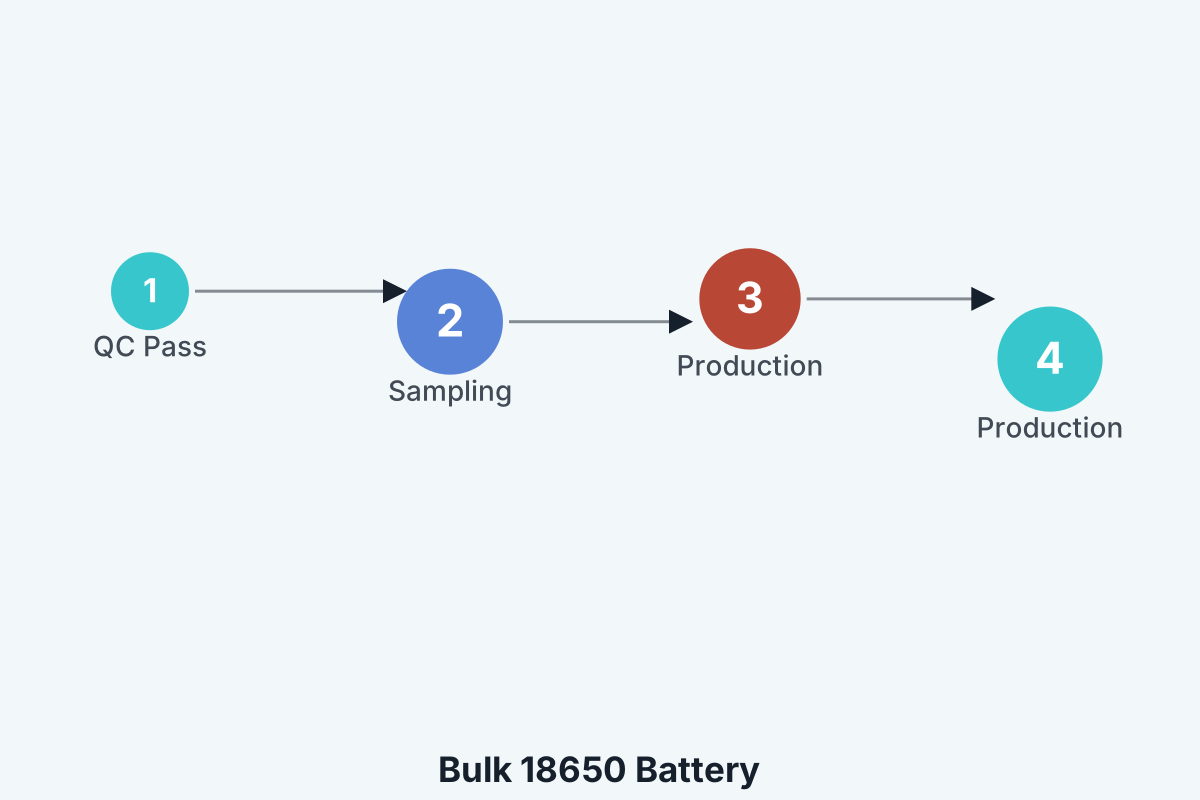
Selling 18650 Battery at Store Level
Put 18650 battery where the decision is made, not where the margin is highest. In most stores that means near the counter or at eye level in the category, rather than wherever there is spare space.
A 18650 battery display that answers strength and flavour without staff involvement outsells a prettier one that does not. Most customers will not ask, so the fixture has to do the work.
Quality Control in Practice
Inspection is only useful if the result is recorded somewhere you can find it later. A 18650 battery batch log with weights, codes and measurements turns a future complaint into a five minute lookup.
AQL sampling gets a lot of attention, but for 18650 battery the more useful habit is simply measuring the same three things on every single batch. Trend lines catch problems that pass/fail checks miss.
- Agree the tolerance band in writing before approving artwork.
- Rotate stock by batch code rather than by delivery date.
- Write the complaint threshold into the order terms.
- Ask how the factory measures puff count, then compare like with like.
- Keep sealed retained samples from every production batch.
Practical Checklist
- Ask how the factory measures puff count, then compare like with like.
- Rotate stock by batch code rather than by delivery date.
- Start with a mixed carton and let your own sell-through decide.
- Plan the switch from air to sea freight before you need it.
- Confirm the current customs classification with your own broker.
- Model landed cost, not ex-works price, when comparing quotes.
Frequently Asked Questions
How long does a 18650 battery order take to arrive?
Production typically takes ten to eighteen working days after artwork approval, and transit depends on the method you choose. Air express is fastest, sea freight is cheapest at volume. We confirm both at quotation so there is no surprise later.
Do you provide compliance documents?
Every shipment leaves with the documentation set relevant to your market, including batch records and test reports where required. Your local rules still determine what you must file, so confirm those with your broker before import.
What if a batch does not match the sample?
Keep the retained samples from the approval stage. If a delivered batch measurably differs, we compare against the retained set and resolve it against the production record. This is why we insist on sealed retained units from every run.
Is there support for in-store material?
Yes. Shelf talkers, counter cards and simple planogram suggestions are available for 18650 battery ranges that reach a sensible volume. Most retailers find the plain strength and flavour cards do the most work.
Next Step
We would rather quote you accurately and lose the order than quote optimistically and lose the relationship. Ask us the awkward questions early.
Related Reading
- 18650 Battery vs Standard Alternatives: What Changes for Your Shelf — Landed Cost Worked Through
- 18650 Battery Staff Training Notes for Store Teams — North America
- 18650 Battery Sample Approval Meeting Agenda — Updated for 2026
- 18650 Battery Seasonal Peaks and Stock Cover — a Printable Checklist
- 18650 Battery Quality Control: Tests We Run Before Dispatch — Specialist Vape Shops
- 18650 Battery Cell and Chip Supply Constraints — Oceania