 VapeWholesaleHub
18650 Battery Counterfeit Risk and Serialisation — Step by Step
Retailers rarely lose money on 18650 battery because of price. They lose money because the first container was bought on a photograph. This page walks through what actually matters when you source 18650 battery at scale, written from the buying desk rather than the marketing department.
How 18650 Battery Fits the Assortment
Before anything else, decide which customer you are buying 18650 battery for. A convenience counter with limited shelf depth needs a tight range that turns quickly, while a specialist shop can carry a deeper ladder of options and educate buyers into higher ticket lines.
Category planning for 18650 battery works best when you map it against three shopper types: the restocker who already knows what they want, the switcher who wants something stronger, and the explorer who buys on flavour name alone.
Inspection Before Dispatch
Most defects in 18650 battery are not dramatic. They are loose tolerances, a slightly thin seal, a mouthpiece that clicks. Left alone they turn into leak complaints, which are the single most common reason a retailer drops a line.
- Confirm the current customs classification with your own broker.
- Model landed cost, not ex-works price, when comparing quotes.
- Keep sealed retained samples from every production batch.
- Rotate stock by batch code rather than by delivery date.
- Start with a mixed carton and let your own sell-through decide.
Modelling a Healthy Margin
Margin on 18650 battery is rarely lost at the till. It is lost through dead stock, returns and emergency air freight. A slightly higher landed cost with predictable lead time usually beats the cheapest quote on the spreadsheet.
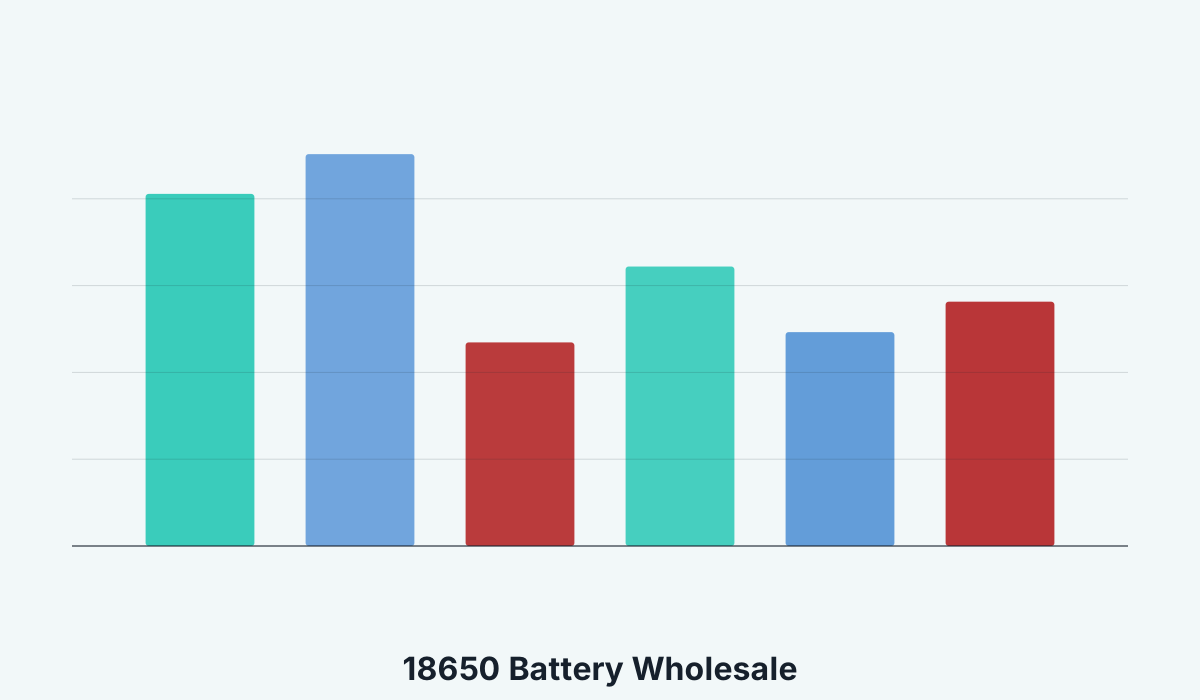
Indicative reference points for planning purposes: entry tier from USD 1.46 per unit at 2000 units, mid tier at USD 0.86, and volume tier at USD 1.49 for full container quantities. These figures move with specification, packaging and freight, so treat them as a shape rather than a quote.
Turning 18650 Battery Into Repeats
Use your 18650 battery staff training time on the two questions customers actually ask. Anything more detailed gets forgotten by the second shift.
Bundle 18650 battery with a complementary item rather than discounting it outright. The perceived value holds up better and the second item often becomes a repeat purchase on its own.
Reading a 18650 Battery Spec Sheet
Ask for the 18650 battery specification in the same units you intend to measure in. A metric quoted in a form you cannot verify on arrival is not a specification, it is a claim.
A written 18650 battery specification should be short enough to read in a minute and precise enough to argue about. If a factory cannot confirm a number in writing, assume the number is whatever is cheapest that week.
| Product category | Pod system |
|---|---|
| Resistance band | 0.8 - 1.0 ohm |
| Capacity tolerance | +/- 5% |
| Puff count method | Machine cycle 2s on / 18s off |
| Master carton | 120 units |
| Carton weight | 11.2 kg |
| Shelf life | 18 months |
| Storage | 15-25 C, dry, away from direct light |
Practical Checklist
- Check carton dimensions against your freight quote before confirming.
- Agree the tolerance band in writing before approving artwork.
- Write the complaint threshold into the order terms.
- Plan the switch from air to sea freight before you need it.
- Ask how the factory measures puff count, then compare like with like.
- Model landed cost, not ex-works price, when comparing quotes.
Frequently Asked Questions
Do you hold stock for regular customers?
For established programmes we can reserve production slots and, in some cases, hold finished 18650 battery stock against a forecast. It removes most of the lead time risk from a reorder and is worth discussing once volumes are stable.
What if I only need a small first order?
That is normal and sensible. A mixed carton lets you test 18650 battery in your own market before committing to a production run, and the specification you approve at that stage carries through to larger orders unchanged.
Do you provide compliance documents?
Every shipment leaves with the documentation set relevant to your market, including batch records and test reports where required. Your local rules still determine what you must file, so confirm those with your broker before import.
How do you handle a short shipment?
Cartons are counted and weighed before dispatch and the figures are shared with you. If something is short on arrival, the packing record and the carrier documentation are both available, which keeps the claim straightforward.
Is there a warranty on 18650 battery?
Manufacturing defects are covered against the retained sample standard. Normal wear, misuse and damage after opening are not. We publish the threshold in the order terms so both sides know exactly what the claim process looks like.
Next Step
We would rather quote you accurately and lose the order than quote optimistically and lose the relationship. Ask us the awkward questions early.
Related Reading
- Setting Minimum Order Quantities for 18650 Battery — EU Markets
- 18650 Battery Inventory Turnover Benchmarks for Stores — Low Minimum Quantities
- 18650 Battery Quality Drift: Catching It Before Customers Do — Landed Cost Worked Through
- Spotting Defects in 18650 Battery Before Shipment — First-Time Importers
- 18650 Battery Review Mining for Product Insight — Convenience Retail
- 18650 Battery Cash Flow Planning for Large Buys — Established Chains