 VapeWholesaleHub
18650 Battery Contract Clauses Worth Negotiating — Repeat Orders
Retailers rarely lose money on 18650 battery because of price. They lose money because the first container was bought on a photograph. This page walks through what actually matters when you source 18650 battery at scale, written from the buying desk rather than the marketing department.
What 18650 Battery Really Costs Landed
Discounting 18650 battery to win shelf space tends to reset customer expectations permanently. Volume support in kind, such as display material, usually costs less in the long run.
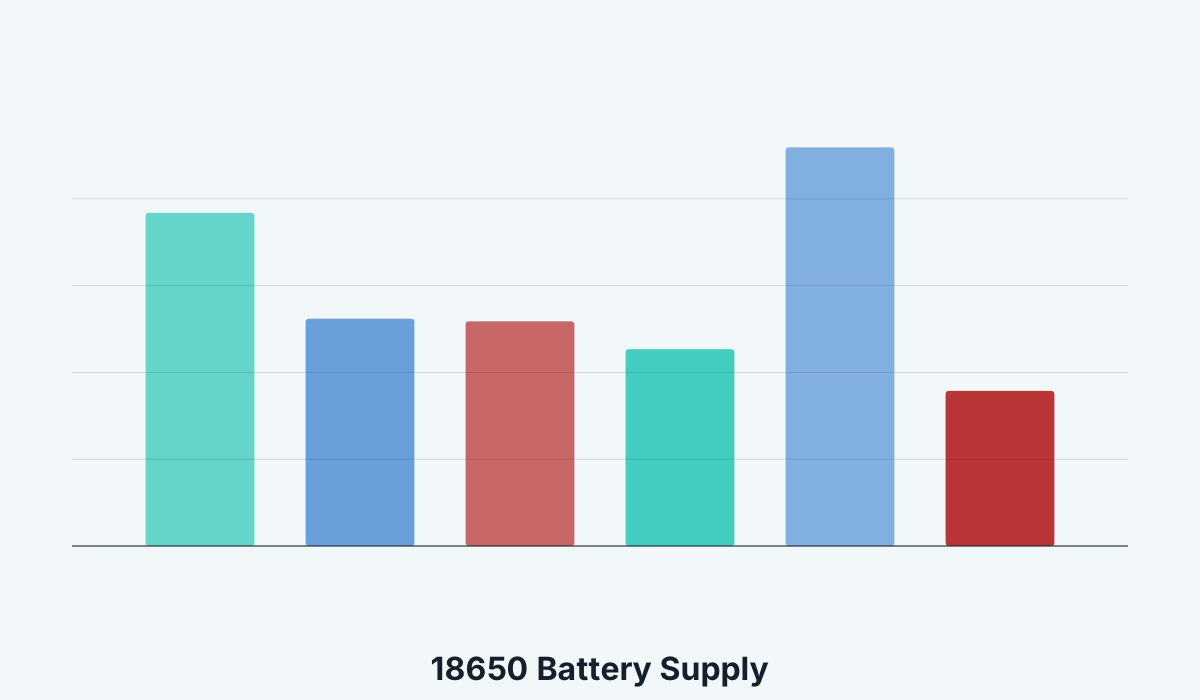
Indicative reference points for planning purposes: entry tier from USD 2.26 per unit at 500 units, mid tier at USD 1.20, and volume tier at USD 0.93 for full container quantities. These figures move with specification, packaging and freight, so treat them as a shape rather than a quote.
Selling 18650 Battery at Store Level
Rotate 18650 battery facing rather than price for the first month. Visibility changes sell-through more reliably than a small discount, and it does not train customers to wait for offers.
Online, the listing for 18650 battery should answer three questions without scrolling: what it is, how strong it is, and what it tastes like. Everything else belongs further down the page.
Inspection Before Dispatch
Incoming inspection for 18650 battery is not about opening boxes at random. We weigh a sample of cartons, check batch codes against the production record, run a draw resistance measurement, and log the results so that a complaint three months later can be traced to a specific run.
- Write the complaint threshold into the order terms.
- Check carton dimensions against your freight quote before confirming.
- Ask how the factory measures puff count, then compare like with like.
- Model landed cost, not ex-works price, when comparing quotes.
- Start with a mixed carton and let your own sell-through decide.
Where 18650 Battery Sits in the Range
18650 Battery sits at an interesting point in the assortment. It is familiar enough to be an impulse purchase and specific enough to build a repeat pattern around. Treating it as either pure commodity or pure specialty both lead to poor results.
Getting 18650 Battery to Your Warehouse
Ask your forwarder for the 18650 battery transit history on your lane, not the advertised schedule. The gap between the two is the buffer you should build into your reorder point.
What to Fix Before Approving 18650 Battery
Ask for the 18650 battery specification in the same units you intend to measure in. A metric quoted in a form you cannot verify on arrival is not a specification, it is a claim.
| Product category | Accessory |
|---|---|
| Resistance band | 0.8 - 1.0 ohm |
| Capacity tolerance | +/- 5% |
| Puff count method | Machine cycle 3s on / 27s off |
| Master carton | 240 units |
| Carton weight | 3.9 kg |
| Shelf life | 24 months |
| Storage | 15-25 C, dry, away from direct light |
Practical Checklist
- Ask how the factory measures puff count, then compare like with like.
- Confirm the current customs classification with your own broker.
- Write the complaint threshold into the order terms.
- Plan the switch from air to sea freight before you need it.
- Start with a mixed carton and let your own sell-through decide.
- Agree the tolerance band in writing before approving artwork.
Frequently Asked Questions
Can the packaging be customised?
Yes. Most 18650 battery programmes use private label packaging once volumes justify the printing plate. We supply dielines, check your artwork for print issues and hold approved files so reorders need no new setup.
What information do you need to quote?
Target specification, approximate quantity, destination and any packaging requirement. With those four we can usually come back with a costed option the same working day rather than a request for more information.
How do you handle a short shipment?
Cartons are counted and weighed before dispatch and the figures are shared with you. If something is short on arrival, the packing record and the carrier documentation are both available, which keeps the claim straightforward.
How should 18650 battery be stored?
Cool, dry and out of direct sunlight. Heat and light are the two things that shorten shelf life fastest. Rotate stock by batch code rather than by arrival date, and keep cartons off concrete floors in humid warehouses.
Do you provide compliance documents?
Every shipment leaves with the documentation set relevant to your market, including batch records and test reports where required. Your local rules still determine what you must file, so confirm those with your broker before import.
Next Step
The best 18650 battery programmes we see are run by buyers who write things down. Specifications, batch records, complaint thresholds - the paperwork is the advantage.
Related Reading
- 18650 Battery Documentation Pack for Customs Brokers — Updated for 2026
- 18650 Battery Monthly Review Ritual for Buyers — Real Numbers Only
- Wholesale 18650 Battery: A Practical Buying Guide for Retailers — Private Label Programmes
- Supplier Audit Checklist for 18650 Battery Orders — Regional Distributors
- 18650 Battery Quality Control: Tests We Run Before Dispatch — Southeast Asia
- 18650 Battery Handling Product Recalls Professionally — New Distributors