 VapeWholesaleHub
18650 Battery Clearance Strategies That Protect Margin — North America
If you are comparing 18650 battery suppliers right now, you are probably looking at three quotes that look identical and cost very different amounts. That gap usually comes down to cell grade, coil consistency and how honest the factory is about tolerances. Let us unpack it.
Modelling a Healthy Margin
Compare 18650 battery quotes on the same incoterm. A price that looks better because it excludes a cost you assumed was included is not a saving at all.
Indicative reference points for planning purposes: entry tier from USD 1.74 per unit at 1000 units, mid tier at USD 1.73, and volume tier at USD 1.26 for full container quantities. These figures move with specification, packaging and freight, so treat them as a shape rather than a quote.
Where 18650 Battery Sits in the Range
Before anything else, decide which customer you are buying 18650 battery for. A convenience counter with limited shelf depth needs a tight range that turns quickly, while a specialist shop can carry a deeper ladder of options and educate buyers into higher ticket lines.
18650 Battery sits at an interesting point in the assortment. It is familiar enough to be an impulse purchase and specific enough to build a repeat pattern around. Treating it as either pure commodity or pure specialty both lead to poor results.
Quality Control in Practice
Set the 18650 battery complaint threshold in the contract before you need it. Deciding what counts as an acceptable defect rate during a dispute is the worst possible time to negotiate it.
Random checks are fine, but weight the sample towards the start and end of a 18650 battery production run. Those are where a line is most likely to drift.
- Agree the tolerance band in writing before approving artwork.
- Confirm the current customs classification with your own broker.
- Write the complaint threshold into the order terms.
- Ask how the factory measures puff count, then compare like with like.
- Model landed cost, not ex-works price, when comparing quotes.
Where Demand Is Heading
Demand for 18650 battery has been steadily rebalancing. The early phase rewarded whoever could ship fastest; the current phase rewards whoever can ship the same thing twice. That shift favours buyers who invest in specification rather than price shopping.
Traceability is moving from a nice-to-have to a requirement in several 18650 battery markets. Building the habit now is cheaper than retrofitting record keeping under pressure later.
Logistics That Protect Margin
Ask your forwarder for the 18650 battery transit history on your lane, not the advertised schedule. The gap between the two is the buffer you should build into your reorder point.
The Specification That Matters
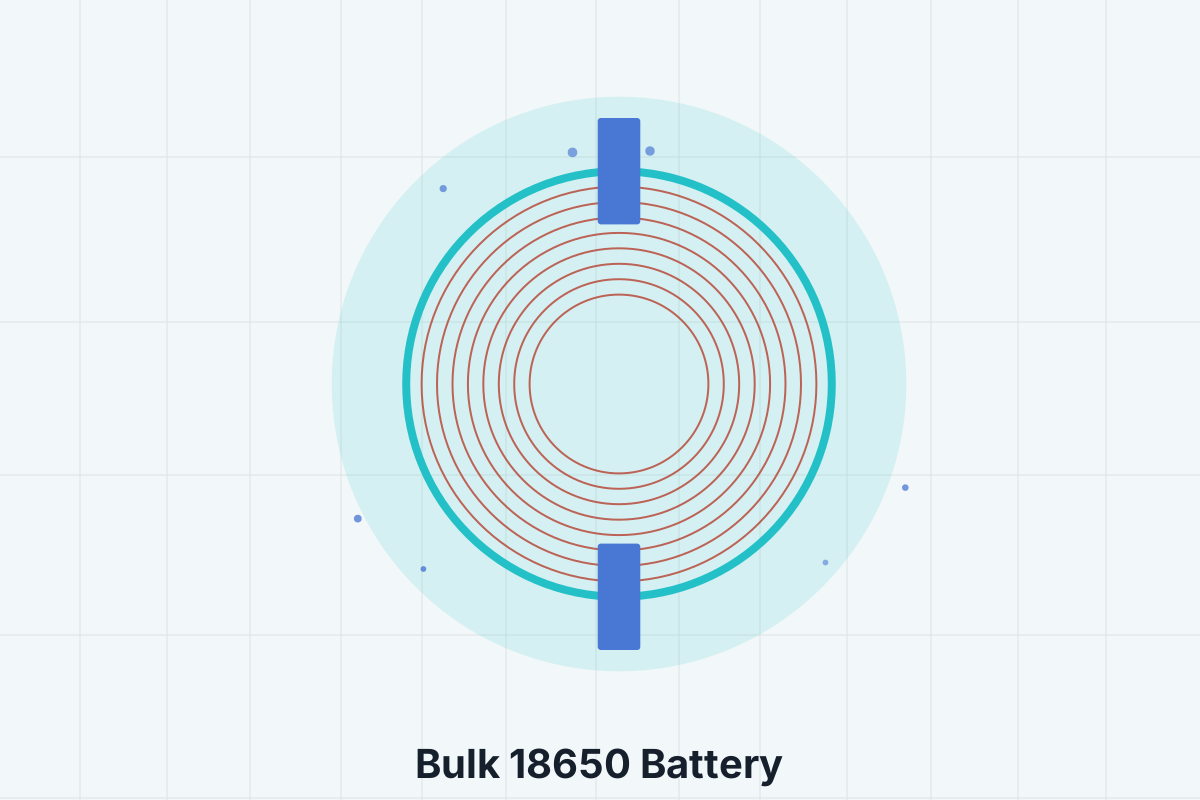
Two specifications that matter more than buyers expect: the seal integrity after a drop test and the consistency of the draw from first use to last. Both are measurable before you commit to volume.
Two specifications that matter more than buyers expect: the seal integrity after a drop test and the consistency of the draw from first use to last. Both are measurable before you commit to volume.
| Product category | Open system |
|---|---|
| Resistance band | 1.0 - 1.2 ohm |
| Capacity tolerance | +/- 5% |
| Puff count method | Machine cycle 2s on / 18s off |
| Master carton | 400 units |
| Carton weight | 11.0 kg |
| Shelf life | 18 months |
| Storage | 15-25 C, dry, away from direct light |
Practical Checklist
- Rotate stock by batch code rather than by delivery date.
- Start with a mixed carton and let your own sell-through decide.
- Confirm the current customs classification with your own broker.
- Keep sealed retained samples from every production batch.
- Ask how the factory measures puff count, then compare like with like.
- Plan the switch from air to sea freight before you need it.
Frequently Asked Questions
What does a sample pack usually include?
A typical 18650 battery sample pack covers the strengths or variants you are most likely to list, packed so you can evaluate them side by side. Tell us which lines you are considering and we will match the pack to that rather than sending a generic selection.
How are price changes handled on repeat orders?
{K} pricing is reviewed against input costs and volume rather than adjusted casually. Any change is confirmed in writing before the next order is scheduled, with the reason stated so you can judge it yourself.
What is the usual minimum order for 18650 battery?
For a standard production run the minimum is normally one master carton per flavour, though mixed cartons can be arranged for a first order. If you are testing the line, ask about a sample pack first and treat the freight as part of your research budget.
What if I only need a small first order?
That is normal and sensible. A mixed carton lets you test 18650 battery in your own market before committing to a production run, and the specification you approve at that stage carries through to larger orders unchanged.
Is there support for in-store material?
Yes. Shelf talkers, counter cards and simple planogram suggestions are available for 18650 battery ranges that reach a sensible volume. Most retailers find the plain strength and flavour cards do the most work.
Next Step
We would rather quote you accurately and lose the order than quote optimistically and lose the relationship. Ask us the awkward questions early.
Related Reading
- 18650 Battery Handling Product Recalls Professionally — Online Sellers
- Certification Routes for 18650 Battery in Different Markets — Tight Margin Categories
- 18650 Battery Insurance Valuation for Held Stock — Established Chains
- 18650 Battery Warranty and After Sales: Setting Expectations — Before Your Next Order
- 18650 Battery Insurance Valuation for Held Stock — Warehouse Teams
- 18650 Battery Product Testing Laboratories Explained — Regional Distributors